
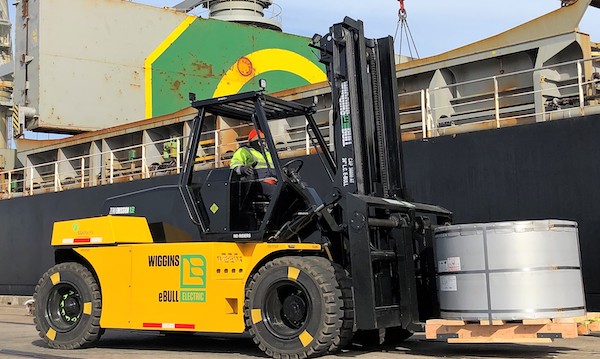
Why Not All Zero-Emission Batteries Are Created Equal
Zero-emission forklifts are no longer a future concept. They’re already here, working daily in ports, terminals, construction sites, recycling facilities, and industrial yards across the country. But as more fleets transition from diesel and propane to electric, a critical detail is often overlooked:
Not all lithium batteries are the same.
Many buyers assume “lithium-ion is lithium-ion.” In reality, lithium-ion is a category… not a single chemistry. And in heavy-duty, multi-shift material handling environments, battery chemistry can directly impact safety, lifespan, reliability, and total cost of ownership.
At XL Lifts, the Wiggins eBull line uses Lithium Iron Phosphate (LFP) battery chemistry, and that choice is intentional.
Before investing in zero-emission equipment, it’s worth understanding what’s inside the battery powering your forklift. Here’s what fleet managers need to know.
Lithium-Ion Is Not One Technology
When manufacturers say “lithium-ion,” they’re often referring to one of several different chemistries. Two of the most common in industrial equipment and electric vehicles are:
- Lithium Iron Phosphate (LFP)
- Nickel Manganese Cobalt (NMC)
Both fall under the lithium-ion umbrella and can power electric equipment—but they behave very differently under stress, heat, heavy cycling, and long-term use.
In light-duty applications (like consumer electronics or passenger vehicles) certain tradeoffs may be acceptable. In heavy-capacity forklifts operating in demanding industrial environments, those differences matter far more.
Safety: Thermal Stability Matters in Industrial Environments
Forklifts operating in ports, marinas, recycling yards, and industrial facilities are exposed to harsh conditions: heat, vibration, continuous operation, heavy loads, and sometimes physical impact. In these environments, battery stability is not just a technical specification… it’s a safety issue.
One of the key differences between LFP and NMC lies in thermal stability.
LFP batteries are inherently more resistant to thermal runaway, the condition in which a battery overheats, potentially catching fire or exploding.. LFP chemistry typically requires significantly higher temperatures before combustion risk becomes a concern compared to many NMC systems. That increased thermal threshold provides an additional margin of safety in high-duty environments.
Additionally, LFP chemistry does not rely on nickel or cobalt. This reduces concerns related to material volatility and can contribute to more stable behavior under mechanical stress or overcharging scenarios.
For fleets operating around valuable cargo, infrastructure, vessels, or public areas, reducing fire risk is not optional. It’s a non-negotiable operational requirement. In heavy-capacity forklifts that may run multiple shifts per day, battery chemistry plays a direct role in that risk profile.
When uptime and safety matter, chemistry choice isn’t trivial.
Durability: Cycle Life and Long-Term Resilience
Beyond safety, cycle life is one of the most important differentiators between LFP and NMC batteries.
LFP batteries are widely recognized for their longer cycle life. Depending on operating conditions, LFP systems can deliver significantly more charge/discharge cycles compared to many NMC alternatives. In real terms, that can translate to years of additional usable service life in high-utilization fleets.
Why does this matter?
Heavy-capacity forklifts in ports and industrial facilities often operate across two or even three shifts per day. Frequent charging and deep cycling are normal—not exceptional. In these environments, a battery that degrades more slowly under full-depth cycling provides tangible long-term advantages.
LFP chemistry is also more tolerant of full charge and discharge cycles without requiring strict charging caps. Some battery systems recommend limiting charging to 80–90% to preserve longevity. LFP systems typically allow for greater flexibility without compromising durability.
For fleet managers, that difference isn’t just technical—it impacts:
- Replacement timelines
- Maintenance planning
- Asset depreciation schedules
- Long-term budgeting
Real-World Longevity vs. Lab Performance
On paper, many battery systems can appear similar. Spec sheets often emphasize peak energy density or short-term performance. But real-world industrial environments tell a different story.
Forklifts in ports and heavy operations experience:
- Continuous multi-shift usage
- High-load lifting cycles
- Heat exposure
- Outdoor conditions
- Vibration and impact
Under these conditions, long-term resilience matters more than peak energy density.
The Wiggins eBull line is now in its eighth year of production, with deployments at major ports and industrial operations across the United States. These are not demonstration units. They are fully deployed machines performing daily operational work.
Battery chemistry plays a foundational role in that real-world durability.
Total Cost of Ownership: The Long View
Upfront cost is often part of the purchasing decision… but for heavy-capacity forklifts, total cost of ownership (TCO) is the more meaningful metric.
Battery lifespan directly impacts TCO in several ways:
- Fewer replacement cycles
- Lower long-term degradation
- More stable performance over time
- Reduced downtime risk
- Stronger residual value
While some battery chemistries may offer slightly higher energy density, durability over thousands of cycles is often more valuable in industrial settings.
For fleets running high-utilization equipment, the cost of premature battery degradation can far outweigh marginal differences in initial purchase price. Extended cycle life and stable long-term performance reduce uncertainty and support long-range capital planning.
In short, the less often you need to replace a battery, the better your overall economics.
Why Wiggins Chose LFP for the eBull
The decision to use Lithium Iron Phosphate chemistry in Wiggins eBull forklifts was intentional. It reflects the realities of heavy-capacity material handling.
Ports, terminal operators, industrial manufacturers, recycling facilities, and marinas require:
- Multi-shift reliability
- Long battery life
- Reduced safety risk
- Predictable performance
The Wiggins eBull line, distributed by XL Lifts, is engineered specifically for these environments. With lifting capacities ranging from 10,000 to 120,000 pounds, these forklifts are designed for serious work—not light-duty applications.
By pairing heavy-capacity engineering with LFP battery chemistry, Wiggins delivers zero-emission forklifts built for sustained industrial use.
This is about more than regulatory compliance. It’s about deploying electric equipment without operational compromise.
Not All Zero-Emission Batteries Are Created Equal
As more fleets transition to electric, battery chemistry will increasingly separate durable, industrial-grade equipment from lighter-duty alternatives.
Zero-emission forklifts are not interchangeable. The chemistry inside the battery affects safety margins, service life, and long-term value.
If your operation runs multi-shift schedules, lifts heavy loads, or operates in demanding environments, understanding the difference between LFP and other lithium chemistries is essential.
At XL Lifts, we work with customers to deploy proven zero-emission forklifts designed for real-world performance. If you’re evaluating electric options or exploring grant funding opportunities, our team can help you assess the right solution for your fleet.
Because when it comes to zero-emission equipment, what’s inside the battery matters just as much as what’s outside.
Explore the Wiggins eBull lineup — and contact our team to discuss your fleet’s needs.